calculating pulmonary vascular resistance
- related: pulmonary artery catheter
- tags: #literature #icu
The pulmonary vascular bed is normally a low-resistance, high-capacitance circuit. Elevations in pulmonary vascular resistance (PVR) are characteristic of many vascular diseases, such as pulmonary arterial hypertension, hypoxic pulmonary vasoconstriction, and venous thromboembolism. The learner is asked to calculate the PVR by using the provided hemodynamic data and a pulmonary artery occlusion waveform.
PVR is a calculated parameter derived from modification of Ohm’s law: PVR = (mPAP - PAWP) / CO, where mPAP is the mean pulmonary artery pressure; PAWP is the pulmonary artery wedge pressure; and CO is the cardiac output.
The mean pulmonary artery pressure can be estimated by adding one-third of the pulse pressure (systolic-diastolic) to the diastolic pressure. In this patient who is breathing spontaneously, pleural pressure, and therefore vascular pressures, drops during inspiration (Figure 2).
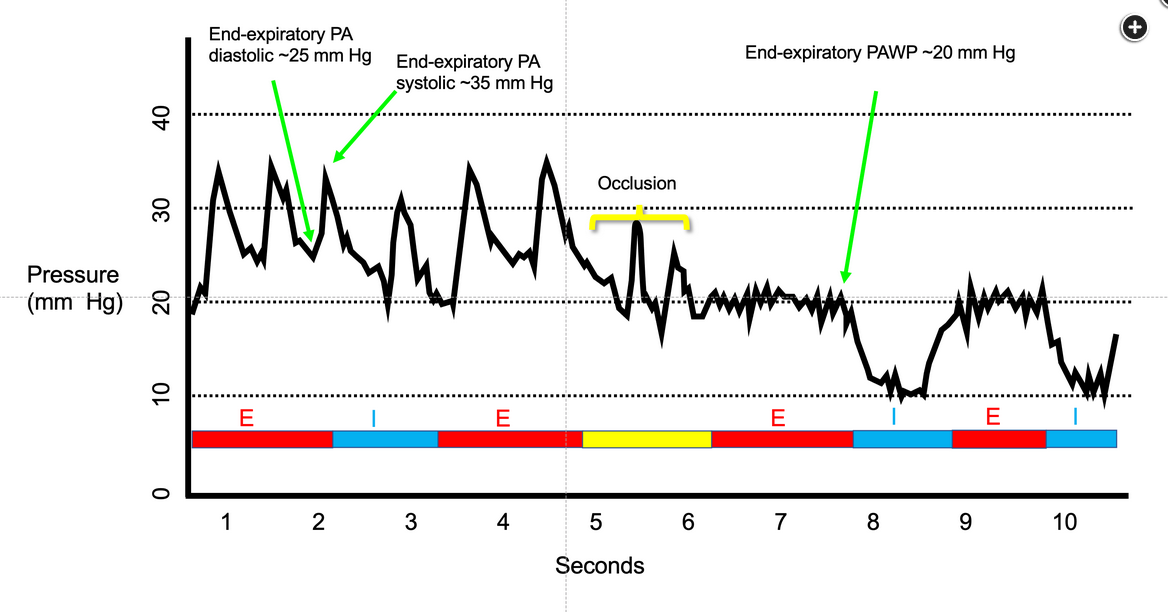
I = inspiration; E = expiration; PA = pulmonary artery; PAWP = pulmonary artery wedge pressure.
At end expiration, pleural pressure is close to 0, and vascular pressures (Figure 2, arrows) most closely approximate transmural pressures. The waveform shows that the end expiratory pulmonary artery systolic pressure is approximately 35 mm Hg, the end expiratory pulmonary artery diastolic pressure is approximately 25 mm Hg, and the end expiratory PAWP is approximately 20 mm Hg. The mPAP can then be calculated to be approximately 28 mm Hg. This patient’s PVR is therefore (28 - 20) / 4 = 2 mm Hg/L/min (160 dynes/s/cm-5).123
Links to this note
Footnotes
-
Ferguson ND. Pulmonary artery catheter education project. Crit Care. 2004;1:1-4. https://doi.org/10.1186/cc2830 ↩
-
Widrich J, Shetty M. Physiology, pulmonary vascular resistance. In: StatPearls. StatPearls Publishing. 2021. PubMed ↩