flow desynchrony can happen with air hunger
- related: basic modes of ventilators
- tags: #literature #icu
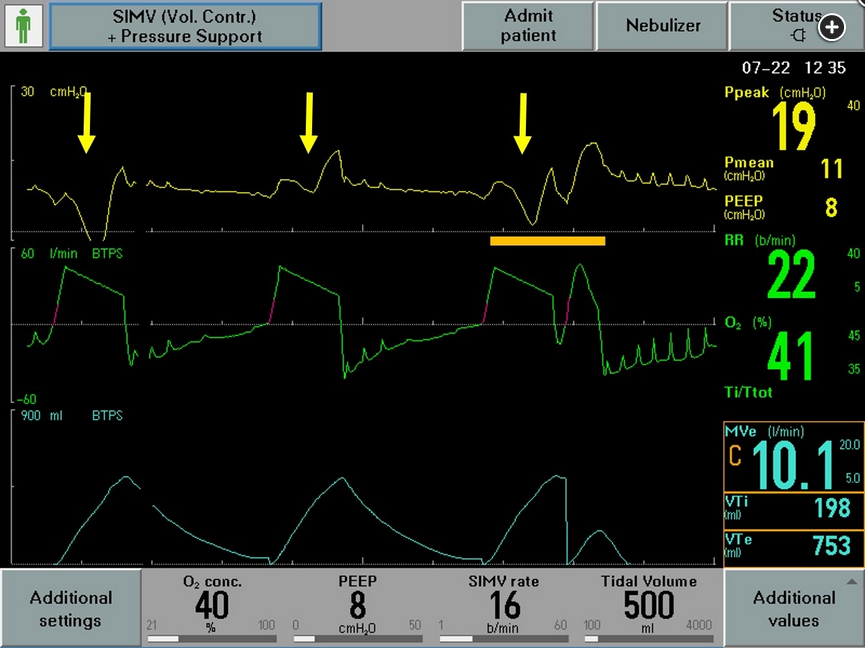
Ventilator graphics including pressure vs time (top), flow vs time (middle), and volume vs time (bottom) that demonstrate flow asynchrony (arrows) and double trigger (bar) asynchronies.
Flow asynchrony occurs when the inspiratory flow is less than the patient desires. This results in patient generation of negative pressure during vigorous inspiratory effort that partially offsets the positive pressure associated with ventilator breath delivery and yields a concave appearance to the inspiratory pressure waveform (Figure 3, arrows) (choice A is incorrect).
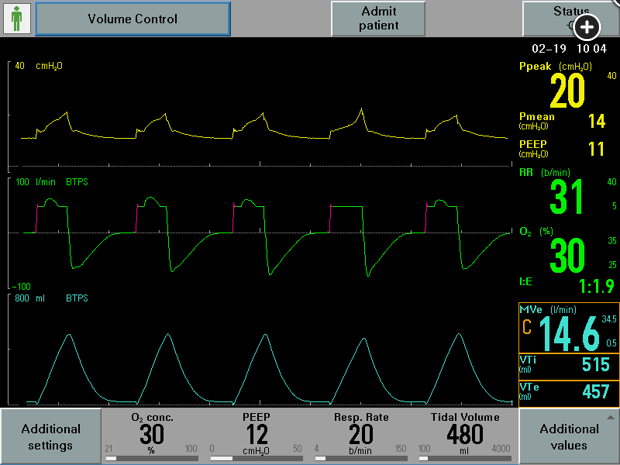
The dominant abnormality in this case can be seen in the pressure graphic. During each breath, airway pressure varies irregularly, sometimes causing downward scooping, which indicates that ventilator flow is not meeting patient demand (choice D is correct).
The implications of flow dyssynchrony are uncertain. Increasing degrees of dyssynchrony correlate with higher mortality, but it is unknown whether this is causal or a marker for severity of illness. Several mechanisms could link dyssynchrony to mortality, such as effort-dependent pendelluft, stress response, increased sedative administration, and others. Oftentimes, dyssynchrony seems trivial and unaccompanied by patient distress, increased work of breathing, or other evidence of potential harm. In other patients, dyssynchrony may provoke distress, failing gas exchange, ventilator alarm, or high work of breathing. Steps that could improve synchrony include raising minute ventilation, changing to a pressure-targeted mode, increasing sedation, shortening inspiratory time (raising flow), or increasing PEEP.1234
Links to this note
Footnotes
-
Esperanza JA, Sarlabous L, de Haro C, Magrans R, Lopez-Aguilar J, Blanch L. Monitoring asynchrony during invasive mechanical ventilation. Respir Care. 2020;65(6):847-869. PubMed ↩
-
Gilstrap D, MacIntyre N. Patient-ventilator interactions: implications for clinical management. Am J Respir Crit Care Med. 2013;188(9):1058-1068. PubMed ↩
-
Rodriguez PO, Tiribelli N, Fredes S, et al; Grupo Argentino de Estudio de Asincronías en la Ventilación Mecánica Study Group. Prevalence of reverse triggering in early ARDS: results from a multicenter observational study. Chest. 2021;159(1):186-195. PubMed ↩