plankton sign and hematocrit sign suggests exudative or hemorrhagic effusion
- related: chest imaging
- tags: #literature #pulmonology
Plankton sign refers to floating, punctiform echoes within a pleural effusion that swirl with respiratory or cardiac motion. This finding suggests an exudative or hemorrhagic effusion.12
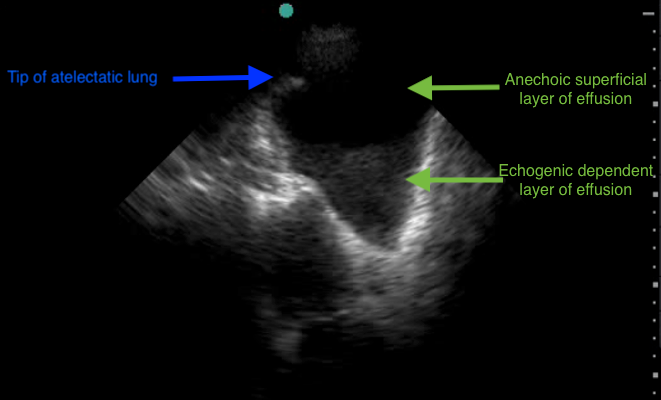
Ultrasonography of the right chest (Video 1) shows a pleural effusion as determined by the presence of a relatively hypoechoic space, bound by the anatomic boundaries of chest wall, diaphragm, and lung, and with the dynamic sign of atelectatic lung tip “swimming” in the fluid. The effusion itself has two different echodensities within it (Figure 2). The more dependent area has greater echogenicity than the more superficial anechoic layer. This occurs in highly cellular effusions, where the cellular debris settles down in the gravitationally dependent area, leaving a relatively clear supernatant. This concept, where cellular material within liquid precipitates out and settles in the dependent area, is the same by which hematocrit is measured in peripheral blood, hence the name hematocrit sign. While hematocrit sign can be present in hemothorax, it is not pathognomonic of blood in the pleural space, despite the nomenclature. It can be seen in any effusion that is highly cellular. Of the options provided, malignant pleural effusion is most likely to exhibit hematocrit sign.
The presence of hematocrit sign also indicates that the effusion is not a transudate, has cellular material and debris in it, and should be consistent with an exudate if sampled and tested. Occasionally, if the fluid sample consists of the supernatant only, it can test as a transudate; therefore, with this phenomenon in mind, if clinically indicated, repeating diagnostic thoracentesis can yield more accurate results.
Hepatic hydrothorax, heart failure, and nephrotic syndrome are all transudative effusions. These typically do not have a large cellular component and would not be expected to develop a hematocrit sign.3