Tracheobronchomalacia vs Excessive Dynamic Airway Collapse
- related:Pulmonary Diseases
- tags: #literature
- links: PDF, source
Persistent Notes
Highlights
- intrathoracic, extratracheal pressure is greater than the intrathoracic intratracheal pressure p.123
- approximately 30% physiologic reduction p.123
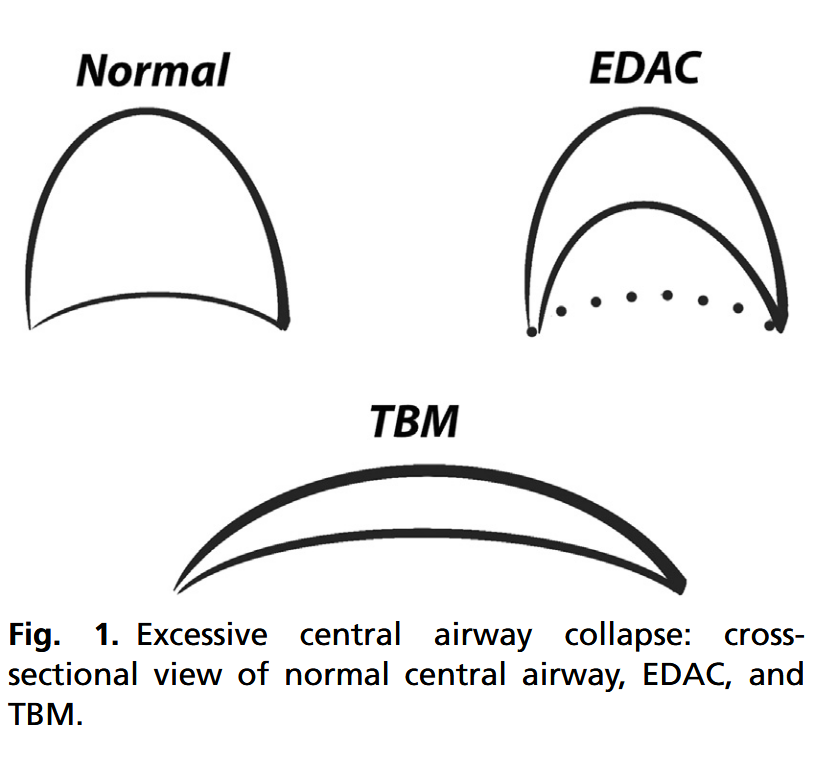
- It consists of 2 distinct entities: tracheobronchomalacia (TBM) and excessive dynamic airway collapse p.123
- widening of the coronal tracheobronchial dimension p.123
- concomitant narrowing of the sagittal tracheobronchial dimension p.123
- anterior bowing of the posterior membranous wall p.123
- without deformation of the cartilaginous structure p.123
- moderate when the cross-sectional area reduction is 80% to 89% p.123
- severe when the cross-sectional area reduction is greater than or equal to 90% p.123
- Tracheobronchomalacia (TBM) is a structural airway abnormality p.123
- cartilaginous weakening of the trachea and bronchi p.123
- Excessive dynamic airway collapse, on the other hand, is characterized by abnormal anterior bowing of the posterior membrane with a normal tracheal cartilage p.123
- Awake dynamic bronchoscopy is the gold standard p.123
- greater than or equal to70% p.123
- dynamic computed tomography (CT) scan of the chest with expiratory and inspiratory phases and awake bronchoscopy p.124
- When the geometry of the tracheobronchial cartilage is preserved throughout respiration p.124
- EDAC p.124
- when the airway is noted to be wider in the coronal dimension and narrower in the sagittal dimension p.124
- normal C-shaped geometry of the tracheal bronchial cartilage is no longer visualized p.124
- TBM p.124
- 14.1% to 23.4% in patients with chronic cough p.124
- up to 53% in patients with stable COPD p.124
- causing atrophy of the tracheal or bronchial cartilages and fibers of the membranous portions p.124
- airway stabilization and stenting p.124
- bronchoscopic stenting versus routine bronchoscopic stenting p.124
- tracheobronchoplasty p.124
- Flow-volume loops from PFTs can demonstrate fixed as well as variable airway obstruction p.124
- Variable airway obstruction can be extrathoracic or intrathoracic p.124
- Both EDAC and TBM p.124
- as variable p.124
- TBM limits airflow and causes symptoms p.124
- debate exists as to whether EDAC results in air flow limitation p.124
- seal-like barky cough p.125
Reference
Lee S, Medina B, Lazzaro R. Tracheobronchomalacia vs Excessive Dynamic Airway Collapse. Thoracic Surgery Clinics. 2025;35(1):123-129. doi:10.1016/j.thorsurg.2024.09.002