use VA ECMO for VF VT arrest patients
- related: ECMO extracorporeal membrane oxygenation
- tags: #literature #cardiology #icu
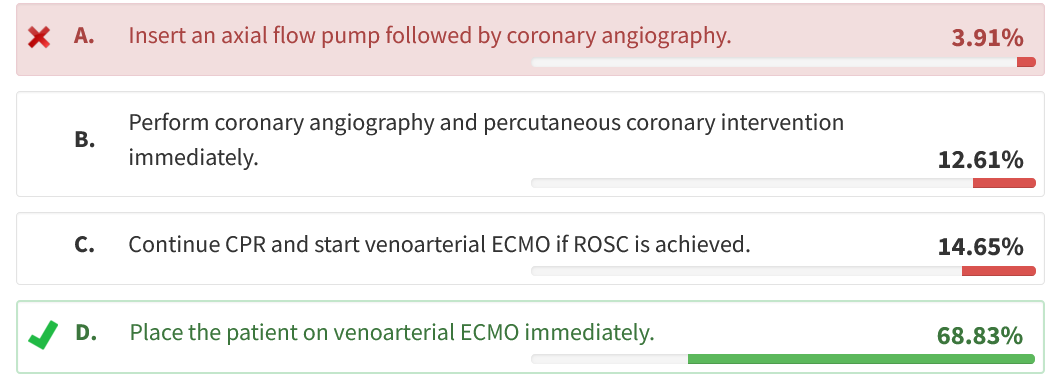
This patient is a good candidate for extracorporeal CPR (eCPR), which entails initiation of venoarterial (VA) ECMO in the setting of cardiac arrest (choice D is correct).
The open-label, single-center ARREST trial showed improved outcomes with eCPR compared with standard advanced cardiovascular life support (ACLS) in patients with out-of-hospital cardiac arrest (OHCA) and VF, with survival rates of 43% vs 7% and favorable neurologic outcomes in survivors. The Prague OHCA trial showed improved survival at 30 days (31% vs 18%) but failed to show benefit in the primary outcome of 6-month survival with good neurologic status (32% vs 22%, P = 0.09). The INCEPTION trial showed no difference in either the primary outcome of 30-day survival with good neurologic status (20% vs 16%) or the secondary outcome of survival with favorable neurologic status at 6 months. These trials had different inclusion criteria, complicating their interpretation. In particular, the Prague OHCA did not require a shockable rhythm at presentation, and the INCEPTION trial allowed time from the 911 call to ECMO initiation to exceed their target of 60 min, with a mean time of 75 min, longer than the average time of 59 min used in the ARREST trial.
Consideration of eligibility criteria for eCPR is vital. In the ARREST trial, patients had to be 18 to 75 years old with VF or pulseless ventricular tachycardia (VT) and no ROSC after three shocks, with an estimated transport time less than 30 min from activation of the ECMO team. Internal bleeding, terminal disease, and body habitus unable to support mechanical CPR were exclusions. Importantly, the ARREST trial was done in a single center with a commitment to providing timely eCPR, with a mobile ECMO van, teams at each of three strategically located hospitals, 24/7 catheterization laboratory availability, and a single centralized ECMO ICU. The patient in this case had no known comorbidities, high suspicion for an underlying acute myocardial infarction that could be addressed by percutaneous coronary intervention as a cause of VF, an acceptably short time since the initial arrest, and a team that could be mobilized quickly. For this patient in this setting, eCPR is a preferred treatment.
When prompt initiation of VA-ECMO is an option, attempting revascularization with the hope that this will allow for successful defibrillation, with or without prior mechanical circulatory support with an axial flow pump, is not likely to achieve revascularization and restore perfusion fast enough to have a successful outcome (choices A and B are incorrect). If VA-ECMO is not an option and these are the only two available choices, then prior mechanical support is preferable; this is because there is some support of cerebral and coronary circulation and reduction of left ventricular load, which may mitigate reperfusion injury. Waiting for ROSC before starting ECMO is not a good option, since even good CPR does not normalize cerebral and myocardial perfusion (choice C is incorrect).
Notably, the results of the ECMO-ACLS trial, which showed no benefit for VA-ECMO in patients with cardiogenic shock, would not apply directly to this case. Although the patients had active cardiogenic shock, those with ongoing CPR and those with CPR longer than 45 min were excluded.
Challenges with extrapolation of the ARREST trial results to other settings also merit consideration. Assembly and maintenance of a team capable of cannulating patients for VA-ECMO within 15 min at any hour of any day is a resource-intensive process. Longer cannulation times will likely produce inferior outcomes. In addition, results of eCPR depend heavily on selection criteria. Expansion of eligibility beyond criteria used in clinical trials may not produce equivalent results, but performance of trials to guide practice in this evolving area is extremely challenging.1234
A 56-year-old patient with no known medical history collapses at home. The patient’s partner witnesses the collapse and starts CPR immediately. Emergency medical service arrives 6 min later and finds the patient in ventricular fibrillation (VF). The patient undergoes cardioversion twice, and return of spontaneous circulation (ROSC) is achieved after 10 min. After transport to the hospital, the patient has another episode of VF. Initial defibrillation is unsuccessful, so the patient is intubated, and a mechanical chest compression device is placed. A second shock successfully restores sinus rhythm. ECG in the ambulance shows anterior ST-segment elevation.
The patient is taken directly to the cardiac catheterization laboratory, but on arrival has VF again and remains in VF despite three more shocks and guideline-based advanced cardiovascular life support (ACLS). It has now been 30 min since the initial cardiac arrest. An extracorporeal membrane oxygenation (ECMO) team is available at the hospital.
Which of the following treatment strategies is most appropriate at this time?
Links to this note
Footnotes
-
Belohlavek J, Smalcova J, Rob D, et al; Prague OHCA Study Group. Effect of intra-arrest transport, extracorporeal cardiopulmonary resuscitation, and immediate invasive assessment and treatment on functional neurologic outcome in refractory out-of-hospital cardiac arrest: a randomized clinical trial. JAMA. 2022;327(8):737-747. PubMed ↩
-
Suverein MM, Delnoij TSR, Lorusso R, et al. Early extracorporeal CPR for refractory out-of-hospital cardiac arrest. N Engl J Med. 2023;388(4):299-309. PubMed ↩
-
Yannopoulos D, Bartos J, Raveendran G, et al. Advanced reperfusion strategies for patients with out-of-hospital cardiac arrest and refractory ventricular fibrillation (ARREST): a phase 2, single centre, open-label, randomised controlled trial. Lancet. 2020;396(10265):1807-1816. PubMed ↩