use vitamin B12 hydroxocobalamin for cyanide toxicity
- related: cyanide toxicity
- tags: #literature #icu
Cyanide poisoning is a true medical emergency and untreated is rapidly lethal. Any patient considered to have cyanide poisoning should be treated with hydroxocobalamin, a precursor of vitamin B12. Hydroxocobalamin contains cobalt, which avidly binds the cyanide to form cyanocobalamin, which is nontoxic, stable, and readily excreted by the kidneys. Because hydroxocobalamin acts rapidly, does not impair tissue oxygenation, and is relatively safe, it is recommended as the preferred first-line treatment.While many patients with cyanide poisoning will need intubation, this patient is breathing adequately, and specific treatment of cyanide poisoning is a more urgent priority. He may need intubation and bronchoscopy for evaluation of smoke and soot exposure at some point but not before treating the cyanide poisoning.
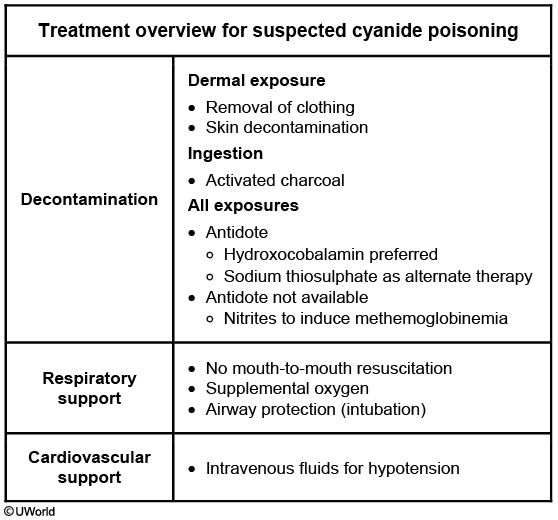
Induced methemoglobin does represent a less preferred treatment for cyanide poisoning. The ferric (Fe3+) moiety of methemoglobin binds cyanide, forming a less toxic cyanomethemoglobin and preventing cyanide from binding the ferric moiety of cytochrome oxidase a3 in the mitochondria. As such, it represents another antidote. Administration of sodium nitrite will induce 15% to 20% methemoglobinemia. However, methemoglobinemia also shifts the oxygen dissociation curve to the left, further hindering oxygen delivery to the tissues. Furthermore, higher levels of methemoglobin, which can occur in children and anemic patients, can be lethal. The complicated pharmacodynamics of safely inducing methemoglobinemia, along with the slower onset of action, makes sodium nitrite a second-line antidote for cyanide poisoning, reserved for times when hydroxocobalamin is unavailable.12345
Links to this note
Footnotes
-
Baud FJ, Barriot P, Toffis V, et al. Elevated blood cyanide concentrations in victims of smoke inhalation. N Engl J Med. 1991;325(25):1761-1766. PubMed ↩
-
Mokhlesi B, Leikin JB, Murray P, et al. Adult toxicology in critical care: Part II: specific poisonings. Chest. 2003;123(3):897-922. PubMed ↩
-
Parker-Cote JL, Rizer J, Vakkalanka JP, et al. Challenges in the diagnosis of acute cyanide poisoning. Clin Toxicol (Phila). 2018;56(7):609-617. PubMed ↩
-
Shepherd G, Velez LI. Role of hydroxocobalamin in acute cyanide poisoning. Ann Pharmacother. 2008;42(5):661-669. PubMed ↩