Wellens syndrome has deep T wave inversion
- related: Cardiology and Hemodynamics, ECG samples
- tag: #note
Significance
- highly specific for critical stenosis of LAD
- very high risk for anterior wall MI in subsequent days to weeks
- do not stress test: can cause MI or cardiac arrest
Dx
- biphasic or deeply inverted T in V2-3
- AND recent chest pain that’s resolved
- normal or slightly elevated cardiac markers
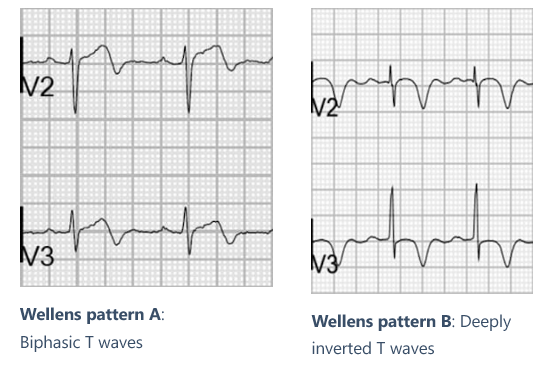
-
Evolution over time:
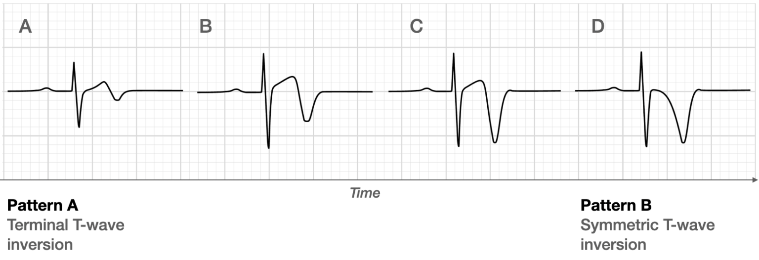
-
can look similar to TWI in severe brain injury (cerebral T wave inversion is sign of SAH and IPH)
Links to this note
-
cerebral T wave inversion is sign of SAH and IPH
- The patient’s ECG demonstrates giant T-wave inversions and QT prolongation. Sometimes known as “cerebral T waves,” these findings correlate with central nervous system (CNS) catastrophes such as subarachnoid hemorrhage (SAH; seen in up to 72% of cases) and intraparenchymal hemorrhage (seen in 57% of cases). Cerebral T waves can also be seen in large ischemic strokes and severe traumatic brain injury. Similar ECG findings can be seen in stress cardiomyopathy and also in profound anterior myocardial ischemia (Wellens syndrome has deep T wave inversion).